
Ethical salience
Trend category
Policy stakeholders
Impact on
Timeframe
Advances in synthetic biology suggest that it may be possible to engineer self-replicating organisms composed of mirror biomolecules—also called 'mirror life'—within the next few decades.
Many biological molecules exist in two mirror-image forms, similar to left and right hands. Life on Earth overwhelmingly relies on just one version. Bioengineering could instead construct molecules such as DNA, RNA, and proteins composed of the opposite, 'mirror' form, creating a mirror-image version of biology. But as human enzymes and immune systems have evolved to recognise only one version, risks may increase heavily before harms are noticeable.
Creating mirror life is not yet possible and may become technically conceivable within the coming decades. Yet the time window to discuss the relevant stopping points for policymaking is now, especially as development progresses along a continuum: from mirror molecules used in therapeutics, to mirror genomes and ribosomes, and ultimately to fully synthetic mirror organisms or mirror life.
The potential risks are profound and possibly irreversible. An early example of the importance of mirror biology came with thalidomide in the late 1950s. Although it involved only a single mirror molecule—not mirror life—its two mirror-image forms can produce dramatically different biological effects. While thalidomide is now used to treat certain cancers, its use during pregnancy in the 1950s caused severe birth defects in more than 10,000 infants worldwide. This drug was based on just a single mirror molecule. However, since a mirror life form could replicate uncontrollably, with no natural measures of containment, prevention is more advisable than countermeasures after its creation.
Mirror biology could offer benefits, like new insights into life, more stable therapeutics, or durable biomaterials, but it also poses significant risks:
The creation of mirror life raises tensions between different values. Policymakers must navigate between scientific openness and technological innovation, and potential (medical) advances, on the one hand, and international solidarity, human and environmental wellbeing and safety on the other hand.
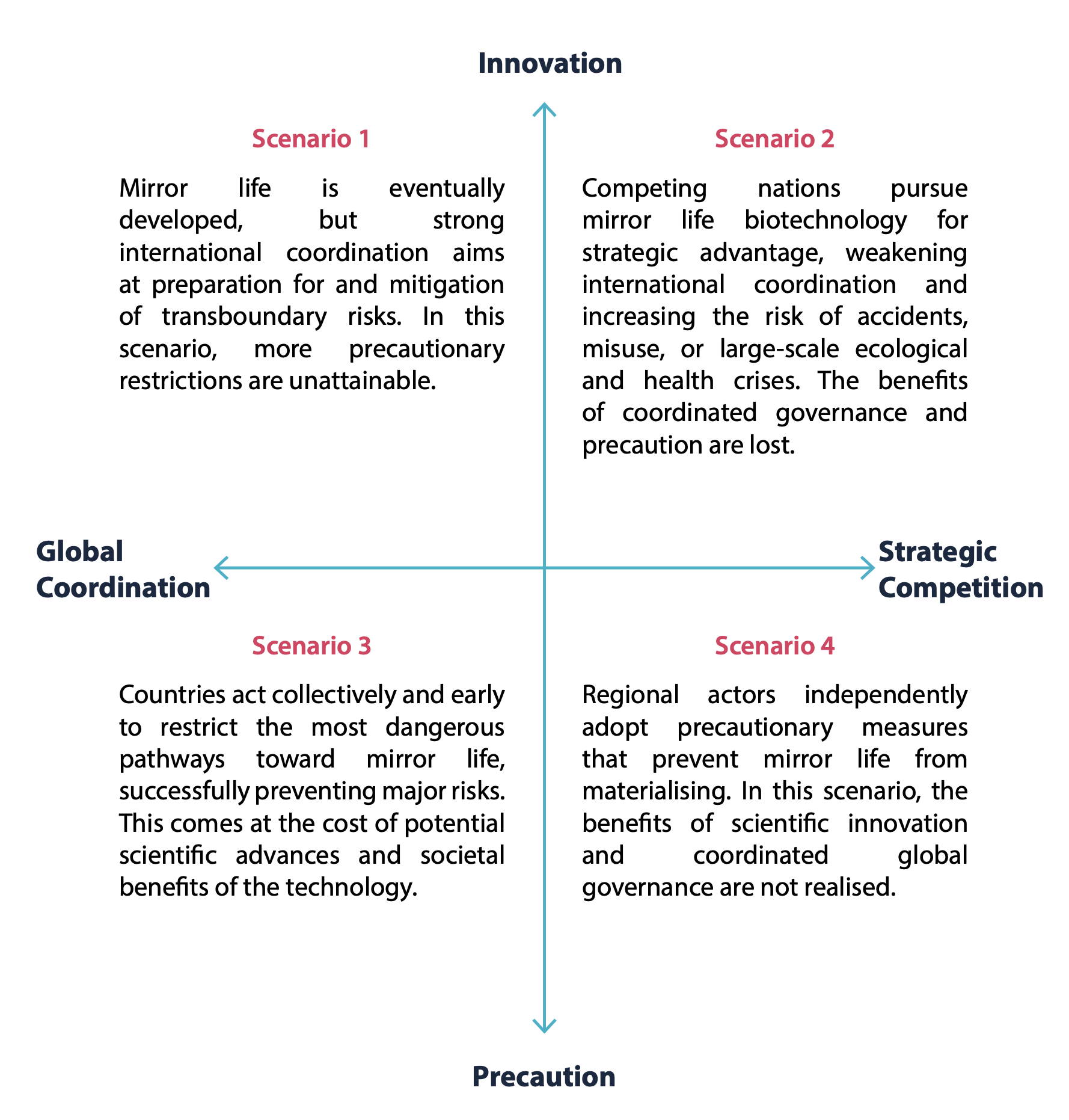
Two key tensions shape uncertainty:
Together, these tensions produce four basic future scenarios, as shown in the image.
Monitor early signals of accelerating technological steps towards mirror life development (e.g. successful synthesis of mirror cellular components, AI-assisted mirror biology design, falling costs for synthetic life forms assembly, increased investment in and funding for the creation of synthetic cells and in particular mirror life) and track (military) research on mirror life globally.
Establish an EU anticipatory governance initiative on mirror life in the near term. Growing awareness about the risks of the creation of mirror life has led to a temporary slowdown in its development. Limiting funding of mirror life research could significantly slow its development. However, once critical technical thresholds are crossed, opportunities for preventive governance narrow considerably. As such, this window of opportunity can be used to identify how effective safeguards can be meaningfully introduced.
Understand wider implications: Mirror life creates a risk as it may create uncontrollable and irreversible effects considering it deals with unrecognisable, self-replicating life forms. This is part of a wider set of risks, including advanced forms of artificial intelligence, driven by rapid technological progress and intensifying geopolitical competition. In such an environment, breakthroughs may outpace societies' ability to assess and govern their consequences, creating global risks that stronger international cooperation and regulation could prevent.
This site uses cookies to store and access information about your device.