
This report presents the Inclusion Plan of the SAEGE project, which sets out its strategy for ensuring diversity and inclusiveness in stakeholder engagement, expert groups, public representation, and evidence-gathering.
The inclusion plan has three elements. First, it explains the importance of inclusive policy advice and hence, why SAEGE will seek to access the lived experiences and expertise of relevant stakeholders. Second, it outlines how the aim to ensure inclusivity in SAEGE outputs will be operationalised within short timescales. Third, it explains how and why SAEGE will make use of an Ethical Matrix to ensure consistency and in-depth scrutiny of the most ethically relevant aspects of each topic under consideration.
Additionally, a range of important practical questions are addressed. What are the visions for inclusive policy making and policy advice? Whose lived experiences are likely to be needed to inform the work of the European Group of Ethics (EGE)? What are the challenges for inclusive policy advice? Which questions need to be asked during evidence-gathering?
And at a more conceptual level, which moral values would form a convincing and stable Ethical Matrix? First answers are found in this report.
This report presents the Inclusion Plan of the SAEGE project, which presents its strategy to ensure diversity and inclusiveness in stakeholder engagement, expert groups, public representation, and evidence-gathering.
The UNESCO (n.d.) defines inclusion as follows:
Inclusion refers to the practice of ensuring that individuals from diverse backgrounds and abilities are actively integrated and valued within various social contexts. It is a fundamental concept in social and human sciences, emphasising equitable access to opportunities and resources.
Equitable access to opportunities and resources for individuals from diverse backgrounds and abilities requires policy effort. In most countries of the world, wealth/class, race, and gender are much more likely to predict access to opportunities and resources than any other personal characteristic.
Having access to wealth, for instance to invest in education, means that the chances for "better health, higher-paying jobs, and overall improved living conditions" (Kivak 2024) are significantly increased. Likewise, the ethnic group that one belongs to is a significant predictor of access to certain opportunities. Speaking about the United States, Braveman et al. (2022) argue that people of colour are systematically denied opportunities such as "access to good jobs with benefits; safe, unpolluted neighborhoods with good schools; high-quality health care; and fair treatment by the criminal justice system" (ibid.). According to the European Union Agency for Fundamental Rights (2023), the situation in Europe is not significantly better.
Regarding gender, the World Bank Group (2022) notes that "178 countries maintain legal barriers that prevent … [women's] full economic participation … In 86 countries, women face some form of job restriction and 95 countries do not guarantee equal pay for equal work." Whilst equal pay for men and women has been enshrined in European treaties since 1957, the gender pay gap in Europe remains at 13% (Buzmaniuk 2023).
Since the late 20th century, sustained inclusion efforts and policies have attempted to overcome systemic barriers that lead to unequal opportunities and life chances. Despite a recent backlash against inclusion movements (Wiley 2026), inclusion remains a prominent objective across many domains: inclusive development (Gupta and Vegelin 2016), inclusion in the workplace (Nguyen et al 2024), inclusion in education (Polat 2011), inclusion of women in politics (UN Women 2026) or business (Cardella et al 2020) and inclusive research (Verhage et al 2024; Mohan and Freedman 2023; Nature Medicine 2024).
Importantly, inclusion is not a zero-sum game in which distributing opportunities and resources more fairly must decrease opportunities and resources for those who were previously privileged. Inclusion efforts do not need to rely on fairness considerations alone. For instance, in the business world, research shows that a commitment to gender equity can generate financial benefits:
The SAEGE project needs an inclusion plan for two main reasons, which also inform the content of this report. It seeks to ensure, as far as possible, that:
This report deals with both points successively.
First, the visions behind inclusive policy making are emphasised, and the options for gaining access to lived experiences are outlined. If individuals from diverse backgrounds and abilities can feed their views into relevant policy topics, for instance, through organisations associated with the EGEAN, policy advice has been made more inclusive.
Second, a pragmatic approach to ensuring that SAEGE evidence-gathering activities are inclusive of diverse stakeholder views within limited timescales is described.
Third, an approach is outlined that aims to sharpen focus upon the most ethically relevant aspects of each topic and provide consistency for analysis of data that is representative of diverse stakeholder perspectives. This will involve application of an Ethical Matrix.
These approaches combined aim to ensure that the needs of individuals from diverse backgrounds, with diverse needs and expertise are taken into account in policy advice focused mostly on science and new technologies in Europe.
Ensuring that the needs of individuals from diverse backgrounds, with diverse needs and expertise are taken into account in policy advice requires purposeful planning; it does not happen automatically.
Inclusion efforts for policy making can be guided by a range of visions from many traditions. Two are worth outlining.
One of the earliest visions for inclusive policy making is encapsulated by the disability rights motto "Nothing About Us Without Us". It means that policies about disabled people must be informed by their input, as disabled individuals are the "primary expert knowers" (Hollomotz et al 2021) of their own needs (Rios et al 2016).
The original motto can allegedly be traced back to the Middle Ages through a Polish constitution from 1505 (see Bath and Willson 2025). In its modern version, Charlton J (1998) notes:
I first heard the expression "Nothing About Us Without Us" in South Africa in 1993 … The slogan's power derives from its location of the source of many types of (disability) oppression and its simultaneous opposition to such oppression in the context of control and voice.
Similarly, "Nothing About Me Without Me" is a guiding principle of health and social care, which aims to ensure that decisions about a person's care, treatment or life are made with their input. Today, the term is increasingly applied in policy making to ensure that health policies are developed inclusively. As noted previously, inclusion can also have an efficiency benefit:
Active and effective partnerships with patients are increasingly recognised as key to improving … health services and policy. Co-designing … yields new insights and tends to lead to better results than healthcare providers, researchers, or policy makers acting on their own (Zelmer 2019 – emphasis added).
The above inclusion mottos are relevant to the EGEAN because they encapsulate the aim of inclusive policy making. Those who are potentially affected by new or revised policies should be able to input (Lemke and Harris-Wai 2015). However, most EGEAN members will not be policy makers, but policy advisors, which means they contribute:
guidance provided to decision-makers regarding the formulation and implementation of policies... This advice is typically based on research, analysis, and expert opinions (UNESCO n.d. 2).
Whilst it is clear that "Nothing about us without us" encourages policy makers to listen to diverse voices, the demand is not directed explicitly at policy advisors. However, it can be applied to them indirectly.
"Policy makers have a limited time to affect change… For citizen insight to be incorporated into the policymaking process we need to provide policy makers with enabling infrastructure to work in this way" (Knight 2021).
Wherever possible, policy advisors should therefore assist policy makers by providing inclusive advice. Consequently, policy advice should aim to take into account the lived experiences and expertise of those who might be affected by the policies.
This is not easily achieved. What one civil servant from the UK observed might also apply to other policy makers and policy advisors: "Not enough diversity in terms of race, age, socio-economic background, disability. The lived experience of the civil service is far too homogeneous" (cited in Knight 2021).
Ideally, policy advisors and policy makers would themselves be drawn from highly diverse groups. This would align with the ideal presented at the start of the report, namely equitable access to opportunities and resources for individuals from diverse backgrounds and with diverse needs and abilities. However, until this is the case, listening to diverse voices is a significant step towards realising inclusion in the context of policy advice.
At the outset of drafting the inclusion plan, the intention was to add relevant organisations to the existing list of potential EGEAN members (see EGEAN Mapping deliverable, forthcoming on www.ethicsadvice.eu), organisations that would then provide access to relevant lived experiences. Following further analysis, this initial plan was modified to strengthen inclusivity and to acknowledge the real-life challenges faced by such organisations.
The reasoning behind this will emerge fully in the following sections, but in brief, an inclusion plan should seek to make provisions for reaching those who face persistent barriers to opportunities, resources, and, by implication, representation, and not just those who are organised in NGOs or similar groups that ensure that their voices are heard.
Inclusive policy making requires access to "primary expert knowers" (Hollomotz et al 2021): people who have first-hand experience of encountered challenges that might be hidden to others. But whose knowledge and voices are needed for inclusive policy advice? Those who do not have equitable access to opportunities and resources, and who can therefore be assumed to have less influence on policy making. They include:
Why distinguish between these two groups? In short, because proportionate representation in policy making would likely suffice to represent the interests of women fairly (who, in the European Union, outnumber men by 4.4% (Eurostat 2025)). However, proportionate representation alone is not sufficient to represent the interests of all disadvantaged groups, some of which are likely to have very specific needs.
To explain with an example, the so-called 'primary aggressor laws' were initially drafted to protect women from arrest. These laws demand that the police identify who is the most likely principal instigator of violence in a domestic violence case and only arrest this person (Hirschel and Deveau 2017). However, women's groups argue that in relation to primary aggressor laws:
"misidentification continues to occur at alarming rates. Too often, women who act in self-defense—or who use violence reactively after years of abuse—are labelled as perpetrators" (Bruns n.d.).
The hope is that representational fairness in decision-making powers would allow sufficient input from women into policy-decisions to avoid a male bias. Currently, women are not represented in proportionately adequate numbers in policy decision-making positions. In June 2025, women held just 38.7% of seats in the European Parliament (European Parliament 2025), still well above the global average of 27.5% for women parliamentarians world-wide (UN Women 2026).
This underrepresentation suggests that, for inclusive policy advice, the policy needs of women must be actively gathered, since it cannot be assumed that their concerns are fully articulated through representation alone. But the vision of proportionately adequate numbers in policy decision-making positions for women remains important. If it were achieved, for instance through the European Commission's (2026) Gender Equality Strategy, which tries to embed gender equality into every aspect of life, the interests of women might be represented well enough to forego additional corrective measures.
The above vision of policy power through proportionate representation only works for men and women; it is far less workable for other disadvantaged groups even when representation numbers are favourable. For instance, the LGBTIQ+ (lesbian, gay, bisexual, trans, intersex, and queer +) Intergroup at the European Parliament has 102 Members (https://lgbti-ep.eu/who-we-are/members/), making it the largest of the European Parliament's 27 Intergroups and representing 14.2% of its 720 members. Whilst it is difficult to obtain reliable figures about how citizens across the EU self-identify (Sell 2017), it is likely that 14.2% is a high enough number for proportionate representation. In Germany, LGBTIQ+ figures are estimated at 11% of the population (Orth 2024); in Denmark estimates suggest 8% (Danish Institute for Human Rights 2023). "On average, across … 30 countries surveyed, 3% of adults identify as lesbian or gay, 4% as bisexual, 1% as pansexual or omnisexual, and 1% as asexual [9%] (Ipsos 2023). The 30 countries included 10 European countries as well as the UK and Switzerland.
It is therefore likely that the LGBTIQ+ Intergroup at the European Parliament achieves a proportionately sufficient level of representation for LGBTIQ+ interests. However, this does not justify the conclusion that EU policies are, by definition, inclusive of LGBTIQ+ interests. This is where point number 2 becomes relevant: some disadvantaged groups may have policy needs that differ significantly from those of the wider population. Even with 14.2% of Members affiliated, it cannot be assumed that every relevant proposal will receive an LGBTIQ+ perspective or impact check, although such scrutiny may at times be essential.
For instance, health and safety policies for researchers or other travellers might miss an extremely important point for the protection of gay and lesbian individuals if they ignore the fact that in 12 countries (Afghanistan, Saudi Arabia, United Arab Emirates, Iran, Mauritania, Qatar, Nigeria, Pakistan, Somalia, Yemen, Brunei, Uganda) the penal code provides for the death penalty for homosexuality (ECPM 2025). Whilst this is an example that is easily discovered via Google, primary expert knowers are likely to be sensitised to risks or concerns that those in majority groups fail to even question.
Typical (though not all policy-related) examples can be drawn from AI 'mishaps'. For instance, an AI system refused a passport for a New Zealander of Asian descent because he allegedly had his eyes closed on the passport photo (BBC 2016). He did not: his eyes were just smaller than those of other New Zealanders, but the system had not been trained inclusively. Another example is the refusal of bank loans to impoverished farmers due to AI seasonal forecasting systems that were designed to help poor farmers but were instead used by commercial banks (Stahl et al 2023). Or the use of facial recognition systems by police forces, which are "very good with white men, very poor on Black women and not so great on white women, even" (Balli 2021). Predicting the potential negative impact of policies on groups with non-majority needs is best achieved by engaging with them.
Due to social, economic, and structural factors, some groups in Europe (and globally) face significant disadvantages and lack of opportunities, resources and representation. For inclusive policy advice and policy making, emphasis should be placed on these groups, the main ones being listed below.
The above groups face systematic, cumulative disadvantages, including a lack of opportunities to influence policy making. Hence, their voices are particularly important in inclusive policy advice. How could this be achieved? The next section describes three challenges.
There are two main ways to access lived experiences of the disadvantaged: first through organisations that represent them, and second, through direct individual contact. Each has its own challenges. A third challenge concerns the timescales for delivering policy advice.
Organisations that can feed lived experiences into decision-making are likely to be NGOs, which leads to the following challenge (which aligns with the experience of the first author of this report, who has been working with NGOs for several decades).
To function well, organisations need a robust infrastructure, which includes, at the very least, reliable information technology and finance systems, as well as good training for staff (Gregory and Howard 2009). This is difficult to achieve for NGOs, which are often assessed on how little they spend on overheads (ibid.). Once an organisation is underfunded, an overworked and insufficiently trained workforce may face health issues and high staff turnover, which in turn leads to operational difficulties and further recruitment problems. This 'nonprofit starvation cycle' (ibid.) suggests that adding further burdens to NGOs without funding (which is not available through SAEGE or the EGEAN) risks further damaging an already weakened system. For instance, if NGOs were simply added to the EGEAN without additional support (see EGEAN Mapping deliverable, forthcoming on www.ethicsadvice.eu), for example, being invited to general webinars and online network events, they could be distracted from their core business, for which they already lack sufficient resources.
It therefore seems more appropriate that SAEGE identify relevant NGOs on a topic-by-topic basis. This way, any input sought for policy advice could be tailored to an NGO's interests and expertise. NGOs could, of course, take part in wider EGEAN activities, but those with limited time and resources could, if this system worked well, rely on SAEGE to identify them at the right time for the right topic.
Searches would be conducted, per ethical issue for which policy advice is compiled, in a systematic manner. The three most important questions, that would be used on each occasion, would be:
The last question is important because the European Union has policies on stakeholder engagement through its Better Regulation agenda.
"Consulting stakeholders is at the heart of the better regulation agenda. The Commission offers citizens and stakeholders the opportunity to provide their feedback online over the entire lifecycle of a policy to collect evidence to support policymaking and ensure transparency" (European Commission, n.d.)
It is reasonable to assume that many of the above listed groups may not make use of this opportunity, for instance, refugees and migrants due to language difficulties and non-familiarity with the policy making process. For inclusive policy advice, it is therefore important to reach these groups for topics of relevance to them in the above-described way (the SAEGE team will identify and contact them on a case-by-case basis).
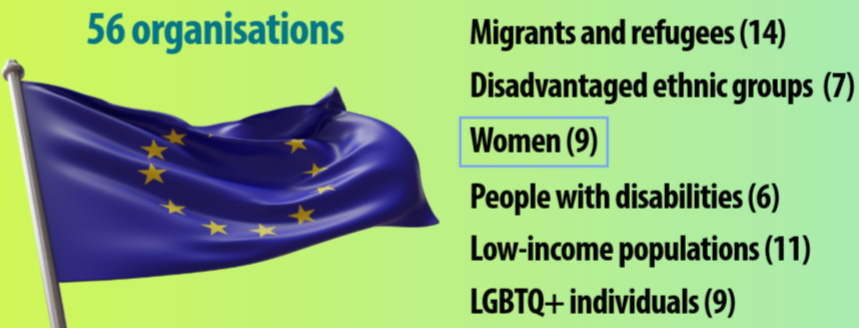
Nevertheless, a list of European support organisations / NGOs was produced (see Annex 1) that represent the interests of the above listed groups who do not have equal access to opportunities and resources within Europe: migrants and refugees, disadvantaged ethnic groups, women, people with disabilities, low-income populations, and LGBTQ+ individuals.
The search criteria were kept simple ("which European organisations support the interests of migrants and refugees" etc.). The Google search was supplemented by searches supported by Claude AI and ChatGPT (a future deliverable of the SAEGE team is on the responsible use of AI, and all team members are currently – informally - comparing different systems).
An obvious objection to accessing lived experiences only through organisations is that this potentially excludes those who are not well organised. It is likely the worst off who might not be organised and this would then undermine the purpose of inclusion efforts. At the same time, trying to reach disadvantaged individuals presents major challenges.
Those with knowledge and experience of accessing lived experiences of disadvantaged individuals usually recommend access through local NGOs or support organisations (Wilson 2024). That is because it can involve significant efforts:
"reaching out to people in the community, building their trust, and supporting people to believe that they have something valuable to say and that it will make a difference … We want people's lived experience to be taken seriously and inform decisions that have an impact on low-income communities. These are the people who have the skills and experience to influence change in a positive way. But it's not easy… (Campbell 2024).
Four immediate challenges are that individuals might:
For those who want to engage directly with individuals to improve policies, the following are also serious challenges:
As a result, it is likely best to work through organisations when accessing relevant lived experiences, whilst remaining open to opportunities to make direct contact as the EGEAN develops. The final challenge is also related to making direct contact, as it can be highly time-consuming.
Policy makers have limited time to consult on each policy issue, and consulting those who may be difficult to reach due to cumulative disadvantage is even more time-consuming. This presents a major challenge for policy advice of an inclusive nature.
This challenge is already clear for the SAEGE project, which adds an additional layer because it feeds information to policy advisors rather than to policy makers.
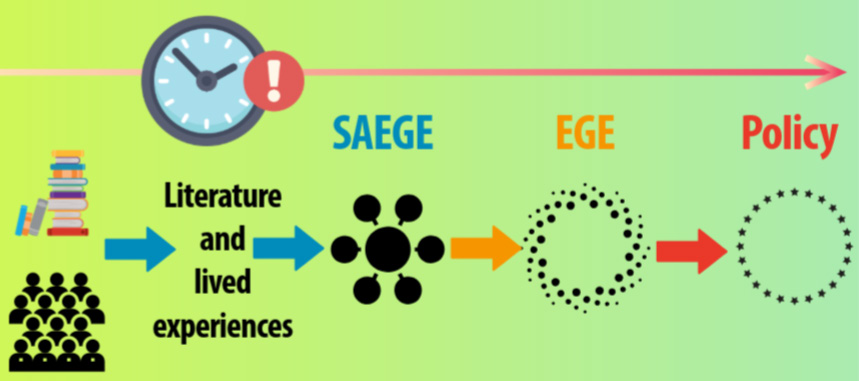
Whilst every effort will be made at SAEGE to provide inclusive information, the above also explains why it is so important that all of SAEGE's work is undertaken inclusively.
This completes the first section, which aimed to explain why we need to identify the lived experiences and expertise of those who are affected by science and technology developments on a topic-by-topic basis, and focusing especially on the disadvantaged groups mentioned (in addition to inviting support organisations / NGOs to the EGEAN). While this section has provided the normative justification for inclusion, we now turn to a more operational question: how SAEGE will actually do this in practice under tight time and resource constraints?
The time constraints on policy makers are considerable. "They often have to come to decisions under time pressure, even when the evidence they have at their disposal is very uncertain" (Lammers 2024). Conducting new, high-quality research or consultation exercises is costly and time-consuming. That is why policy advice is often based on existing research, which likely also has the advantage of being peer-reviewed and validated.
Because SAEGE topics may need to be delivered within different timeframes, inclusion activities must be carefully targeted, proportionate, and feasible. It would neither be realistic nor necessary to undertake new stakeholder engagement for every topic. Further, in some cases, existing evidence may already provide substantial insight into the lived experiences of affected groups. In others, important perspectives may be absent and supplementary empirical activities may be required. The appropriate approach for each topic will be determined systematically rather than on an ad hoc basis and in consideration of the following factors:
At the outset of work on each topic, SAEGE will undertake a rapid scoping exercise. Online search tools will be used to reveal:
Output: A short internal scoping note identifying what kind of inclusion input is likely to be required.
The selection of groups for inclusion activities (desk based or empirical) will not be based solely on general categories of disadvantage. It will also consider which groups are most likely to be specifically affected by the topic under consideration. The main identified groups will, ultimately, be named stakeholders on the Ethical Matrix (see next section).
This requires assessment of both:
The following questions will help guide appropriate inclusion priorities:
Output: Stakeholder list.
Before deciding whether new empirical engagement is necessary, SAEGE will conduct a focused scan of available evidence that is relevant to those most highly prioritised in Step 2. Relevant sources may include:
The gathering of existing evidence will enable determination of whether the experiences and concerns of priority groups are already sufficiently documented and usable for policy advice. Where robust evidence already exists, sufficient inclusion may be achieved through analysis of literature-based evidence rather than new empirical activity.
Output: Spreadsheet of existing literature-based evidence.
Where new engagement is being considered, the types of activities under consideration will be assessed for the need of ethics approval or other safeguarding requirements. This may be particularly relevant where activities would involve any of the following: direct engagement with individuals in vulnerable situations; collecting sensitive personal experiences, health-related information or trauma-related experiences; or participants in situations of dependency or heightened risk.
If ethics approval is required, this will be weighed against the available timetable. In shorter delivery cycles, desk-based activities or organisational consultation routes may be the only options available.
Output: Recommendation for empirical input.
Following Steps 1–4, the most appropriate pathway will be selected, A, B or C.
| Pathway | A | B | C |
|---|---|---|---|
| Strategy | Desk-based | Organisational / expert input | Direct engagement |
| Rationale for choice |
|
|
|
| Options for methods |
|
|
|
* Inclusive sensitive conversations are an approach developed by the author team together with colleagues from the UK, Kenya and South Africa (Schroeder et al 2024).
Output: Recommendation for pathway
All evidence gathered whether desk-based, organisational, expert-led, or directly participatory will be analysed via the Ethical Matrix (see next section). Data relevant to each stakeholder will initially be sorted by value (deductive analysis), before further collapse and (inductive) analysis into themes. As is usual for application of an ethical matrix, this will help to reveal areas of ethical importance. When using the TRUST values (see below), these will include: patterns of unfairness, lapses in care, consequences of disrespect and dishonesty; differing stakeholder perspectives; ethical tensions; ethics pitfalls and potential blind spots.
Output: Findings and conclusions
Where feasible, contributors will be informed how their input was used by SAEGE. For future reference and learning, SAEGE will retain internal learning notes on useful evidence sources, successful methods and challenges encountered and, where appropriate, publish results in a peer-reviewed international journal to spread good practice.
In the mid-1990s, bioethicist Ben Mepham developed a tool that has been used by many to inform policy advice on ethical challenges of new technologies. Our suggestion for ensuring that SAEGE's outputs are both inclusively informed and ethically relevant is built on his Ethical Matrix.
"The Ethical Matrix was developed to help decision-makers explore the ethical issues raised by agri-food biotechnologies" (Kaiser et al 2007).
Ben Mepham, the inventor of the Ethical Matrix, also coined the term 'food ethics' (Mepham 1996) and founded the pioneering and highly influential Food Ethics Council UK.
His matrix built on other long-standing techniques designed to make policy decisions more impartial and inclusive. For instance, John Rawls's famous 'veil of ignorance' can be regarded as a predecessor to the Ethical Matrix. The veil aims to ensure that biases due to class, race, gender etc are excluded in (policy) decision-making (see right).
What Mepham adds to the veil of ignorance are two elements that potentially improve the reliability of the technique in overcoming bias. First, all stakeholder groups are explicitly named and second, the same moral values are considered for each stakeholder group in turn.
Mepham's matrix uses three moral values (or principles), namely wellbeing, autonomy and justice (for a critique of the choice, see below or, for instance, Schroeder and Palmer 2003). A simple, example Ethical Matrix using Mepham's original design could look as follows:
| Respect for: | Well-being | Autonomy | Justice |
|---|---|---|---|
| Farmers | |||
| Consumers | |||
| Animals | |||
| Environment |
All intersections of values with stakeholders would need to be discussed before coming to a (policy) decision. Where there appears to be incongruence between stakeholder and value, for instance, autonomy and animals, Ben Mepham and the Ethical Matrix community have developed certain approaches. For the example of animals and autonomy, it might be assessed whether an animal still has the possibility to act according to its own nature and species-specific behaviours (Webster 2014).
Whilst the original idea of the Ethical Matrix will be retained, the values used in the SAEGE Matrix will differ.
For his matrix, Ben Mepham chose the moral principles used by Beauchamp and Childress (2013) in biomedical ethics: beneficence and non-maleficence (which Mepham combined to wellbeing), autonomy and justice.
These four principles were already heavily criticised 30 years ago for being too strongly based on a US-American model of ethics (Holm 1995) and thus focused on moral values that are not necessarily shared across humanity. This criticism applies in particular to the focus on autonomy (Schroeder et al 2019).
For the SAEGE model, two value frameworks are proposed as more appropriate, even though others are conceivable.
The first suggested framework uses the values of the TRUST Code (2018), which can be understood as global in nature (for justification of this claim, see next section): fairness, respect, care and honesty.
The second suggested framework uses the core values of the European Union: respect for human dignity, freedom, democracy, equality, the rule of law, and human rights—including minority rights (European Parliament 2021).
Ideally, one would want a set of global moral values to ensure that all ethical dimensions of a policy topic are covered, and all relevant stakeholders included in the assessment. Ideally (we explain why in the next section), these values should also be stable.
However, according to many philosophers, there are no global, moral values. Moral values, they argue, are culturally variable, subjectively defined and linked to time and place (Harman 1978). Famous moral relativist, Friedrich Nietzsche (1844-1900), notes: "Moral values are not universal and absolute, but are … conditional constructions of particular group at particular times with particular goals" (Ezung 2021).
Whilst there is significant work ongoing to identify global values, efforts are rarely focused solely on moral values. For instance, a survey published by the World Economic Forum (2020) visualised "The world's most influential values, in one graphic". Data were obtained through half a million surveys in 152 languages. However, the values identified in this exercise include items such as "material possessions" or "leisure" (ibid.), which make sense as values, but not as moral values for an ethics matrix. Besides, assessing all stakeholder interests for 56 values (the number highlighted by the above effort) would not be feasible.
There is another, more pragmatic way of arriving at global moral values. If a moral framework was developed by a group representing all continents, with a special emphasis on involving marginalized populations, and the product of their work had been applied successfully all over the world, one could reasonably argue that this framework has managed to encapsulate global moral values, even if this was an unintended side-effect. This is what happened with the TRUST Code (2018).
For the TRUST Code, a global group representing all continents, including highly marginalised populations on the extreme poverty line, identified 88 exploitation risks in international research.
When the moral values that were being violated in these exploitation cases were extracted through philosophical analysis, they were immediately recognised by all members of the global group. Fairness, respect, care and honesty emerged as key moral values across all communities. When the approach was repeated for the PREPARED Code (2025) for research during pandemics and the TRUST Code Supplement (2025) for research in fragile settings, 144 and 94 ethics and integrity risks respectively were again found to be associated with violations of fairness, respect, care and honesty (Chatfield et al 2024 and Schroeder et al (in print)). Since then, the TRUST Code has been adopted by organisations all over the world (https://www.globalcodeofconduct.org/trust-code/). Hence, at least in research ethics and integrity, fairness, respect, care and honesty are recognised as globally valid and as highly significant, ahead of other moral values. For a short explanatory video, see below.
The four TRUST values have also been used successfully in policy advice (Chaturvedi et al 2023), as Nature (Padma 2023) reported. The high-level policy recommendation to include the African Union in the G20 was built on the values of fairness, respect, care and honesty and proved successful. Commenting on the approach, the Nature piece included the following:
"The 'Advocating for a G21' document is "a good model of how to include ethics in decision-making", says Katherine Littler, co-lead of the World Health Organization's Health Ethics and Governance Unit in Geneva, Switzerland (ibid.)."
For a short video explaining the policy approach using fairness, respect, care and honesty to advocate for a G21, see right.
https://www.youtube.com/watch?v=CCgQ5ntnrxE&t
It was therefore decided by the SAEGE team that the Trust Values would provide a suitable basis for an ethical matrix for the inclusive assessment of ethical implications of policy issues.
Another candidate for a stable moral framework is the set of moral values of the European Union: respect for human dignity, freedom, democracy, equality, the rule of law, and human rights. However, the SAEGE team still has to verify the suitability of these values for use in an ethical matrix, whilst the TRUST values have already been tested in policy advice. Possibly significant challenges include the following:
Watch this space whilst the SAEGE team assesses whether the European values are suitable for use in an ethical matrix.
Whilst other moral frameworks are possible and could be considered in the future, the choice of moral values should not be ad hoc and easily interchangeable. This aligns with expectations of common morality, which refers to an approach that argues that thoughtful people can arrive at moral judgements without extensive expertise in moral theory (Gert 2004).
People seem to expect moral judgments to be stable in a way that contrasts with tastes. Many diners order pasta one day and pizza the next. Nobody criticises them for changing what they prefer to eat, even if they have no reason to change. In contrast, if someone says on one day that capital punishment is immoral and then says on the next day that it is not immoral, then we suspect that this person would be subject to criticism… (Rehren and Sinnott-Armstrong 2023).
A more philosophical explanation of why moral values in any inclusion plan should remain stable could be linked to Immanuel Kant (1724-1804). According to Kant (1997:20, 4:408), rational human beings can distinguish between a moral right and a moral wrong quite easily because their faculty of reason has access to the moral law (ibid.) (simplified, a type of Golden Rule - treat others as you want to be treated). However, human beings also tend to try and rationalise exceptions for themselves (Sticker, 2021). In terms of moral values, somebody might argue, 'my actions score well on honesty, but not so well on fairness, why not drop fairness from the framework just this once?'
Rationalisation is a concept that is recognised in (social) psychology under different names, including moral disengagement (Bandura 2011), whereby "people can do unethical things without distress, using various cognitive mechanisms" (Redman and Caplan 2017). Rationalisation could also be used to switch between moral frameworks to use those that are more amenable to one's aims. But pragmatic choices of moral values are not moral choices:
if someone judges that it is morally wrong to lie because honesty is a moral value, then they should continue to value honesty and think that it is wrong to lie in different contexts where the lie is about a variety of topics and the lie is told to strangers, friends or colleagues (Rehren and Sinnott-Armstrong 2023).
Moral frameworks need stability to be convincing and to prevent easy rationalisations, which is why we are suggesting two stable moral frameworks one based on the values of the TRUST Code and one based on the core values of the European Union (which still has to be tested for suitability as part of an ethical matrix).
Inclusion movements are omnipresent, and rightly so. Everybody should have equitable access to opportunities and resources regardless of their background or abilities. Achieving this requires policy effort. In most countries of the world, wealth/class, race, and gender are much more likely to predict access to opportunities and resources than any other personal characteristic.
Inclusive policies are best designed and refined with input from those they seek to include. Today, "Nothing about us without us" is not only a slogan of the disability rights movement, but a global motto for inclusive decision-making, including policy making.
This inclusion report described the ways that SAEGE will try to ensure that outputs are both inclusively informed and ethically relevant. This will involve a range of activities that are tailored to the topic under consideration as well as the time scale for delivery and include both desk based and empirical activities to obtain insights into lived experiences and expertise. Importantly, wherever feasible within given time scales, all data, regardless of source (empirical or desk based), will be analysed through an Ethical Matrix to ensure consistency and in-depth scrutiny of the most ethically relevant aspects of the topic. These ambitions are not without challenges.
The non-profit starvation cycle limits what NGOs can do to help SAEGE and the EGEAN to access lived experiences. NGOs often face underfunding combined with an overworked and insufficiently trained workforce, which in turn leads to operational difficulties and further recruitment problems. SAEGE should not add further burdens. For this reason, it was suggested that SAEGE staff will try to identify NGOs whose clienteles are likely to benefit from input into specific policies - on a case-by-case basis.
The main challenges involved in obtaining lived experiences directly from individuals (to avoid missing the worst off, who might not be organised through NGOs) are even more numerous, ranging from trust issues, consultation fatigue, stigma and practical difficulties (such as reimbursement questions, translation and ethics approval).
Added to the above are the time challenges that are always present in the policy advice cycle.
Challenges regarding the Ethical Matrix that is meant to ensure that SAEGE outputs are inclusively informed and ethically relevant mostly focus on the choice of moral values and, again, the time challenges in the policy cycle.
The SAEGE team will make every effort to provide inputs that are inclusively informed and to invite organisations that can access underrepresented, marginalised groups into the EGEAN. Not doing so could lead to inferior policy advice and inferior policies. This is not an option in a world that urgently needs inclusive policy making.
Doris Schroeder is Professor of Moral Philosophy and Director at the Centre for Professional Ethics, University of Lancashire UK and also involved part-time in SAEGE as a staff member of EUREC.
She has worked with NGOs since the age of 16, when she was the youngest founding member of a grammar school amnesty international group.
Doris has given invited, in-person presentations on global justice issues on all continents and in 30 countries. She is also the lead author of three of the four TRUST Family Ethics Codes (https://www.globalcodeofconduct.org/).
Kate Chatfield is Reader in Empirical Ethics at the Centre for Professional Ethics, University of Lancashire UK. She is the former Editor-in-Chief of SAGE Research Ethics.
Kate has experience and expertise in both ethical analysis and empirical research methods and she has research ethics expertise across many disciplines including clinical studies, social sciences, emerging technologies, animal experimentation, humanities, the inclusion of vulnerable persons in research, equitable research in low- and middle-income settings, research in fragile settings, and responsible research and innovation.
We tried to use language in this report as sensitively as possible, please let us know if you have advice for improvements. And please let us know any suggestions for groups that are able and willing to provide access to lived experiences in the context of ethics advice for science and new technologies.
The following list includes mostly support networks rather than individual NGOs to avoid depleting the resources of NGOs that may be affected by the Nonprofit Starvation Cycle. In addition, all organisations listed work at the European level rather than in Member States or outside of the EU. Importantly, this is a starting list. The engagement between the EGEAN and support organisations has to be developed iteratively, in collaboration with interested partners.